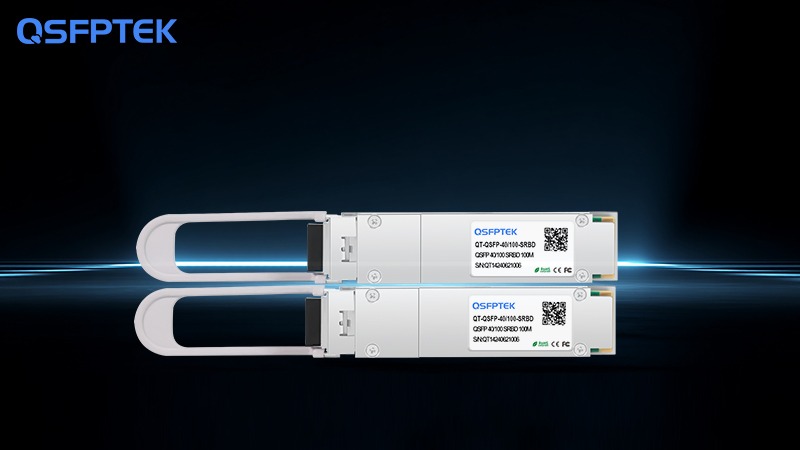
In today’s data centers, driven by cloud computing and 5G, the shift to 100G connectivity is essential. For links under 100 meters, which are very common, multimode fiber solutions provide a cost-effective backbone. Two prominent QSFP28 transceivers designed for this space are the 100G SRBD and the 100G SWDM4. While both serve high-speed, short-reach applications, their underlying technologies and ideal use cases differ significantly, influencing the optimal choice for network architecture.
Understanding the 100G SRBD Transceiver
The 100GBASE-SRBD (Short Range Bidirectional) module is engineered for efficiency in high-density environments. Its core innovation is bidirectional (BiDi) communication, which allows it to transmit and receive data over a single strand of multimode fiber. This is achieved using two distinct wavelengths—typically 850nm for one direction and 900nm for the other—through a standard duplex LC interface.
This approach effectively doubles the capacity of an existing fiber strand, making it an excellent solution for maximizing port density and simplifying cable management. In terms of reach, the SRBD module supports up to 70 meters on OM3, 100 meters on OM4, and extends to 150 meters when used with the newer OM5 fiber, which is optimized for wider wavelength ranges. Besides, the 100G SRBD like the H3C QSFP-100G-BIDI-MM850 supports both 40G and 100G. Its design is particularly advantageous for spine-leaf interconnections and other applications within a data hall where fiber infrastructure is at a premium.
Exploring the 100G SWDM4 Transceiver
The 100GBASE-SWDM4 (Short Wavelength Division Multiplexing 4-lane) module takes a different path to achieve high data rates. It utilizes a single fiber pair but employs four different wavelengths within the shortwave band (850nm, 880nm, 910nm, and 940nm) multiplexed onto each fiber. This technology leverages existing duplex OM3 or OM4 cabling commonly found in data centers.
By transmitting multiple signals concurrently over a single fiber core, SWDM4 efficiently boosts bandwidth without requiring a complete overhaul of the physical fiber plant. It is standardized for reaches of 70 meters on OM3 and 100 meters on OM4. This makes it a strategic choice for organizations seeking to upgrade their network speed to 100G while protecting their investment in installed multimode fiber infrastructure, especially in high-density server aggregation scenarios.
Key Technical Comparison and Application Guidance
The fundamental difference lies in their spectral strategy: SRBD uses two wavelengths bidirectionally on one fiber, whereas SWDM4 uses four wavelengths multiplexed on a fiber pair. This gives SWDM4 higher spectral efficiency for duplex fiber, while SRBD BiDi QSFP28 offers superior fiber strand savings.
The choice between them often depends on specific data center constraints and future plans:
Choose 100G SRBD if: Your priority is maximizing the utility of every single fiber strand or you are deploying new OM5 fiber to achieve the longest possible reach (150m) within a multimode environment. It is also the preferred option if you anticipate a future migration path to 400G networks, as it offers better compatibility for breakout configurations.
Choose 100G SWDM4 if: Your goal is to unlock 100G performance over your existing duplex OM3/OM4 cable plant without recabling. It is ideal for efficiently utilizing installed infrastructure for high-density connections within standard 70-100 meter distances. It generally offers favorable power efficiency.
It is crucial to note that these two transceiver types are not interoperable; each requires a matching module at the opposite end of the link.
Conclusion
Both the 100G SRBD and 100G SWDM4 transceivers provide robust pathways to 100G connectivity in the data center. The SRBD module stands out for its fiber conservation and extended reach with OM5, offering a forward-looking solution. Conversely, the SWDM4 module excels as a transitional technology that breathes new life into legacy multimode cabling systems. The optimal decision hinges on a careful evaluation of current fiber assets, distance requirements, density goals, and long-term network evolution strategy.
About the Author