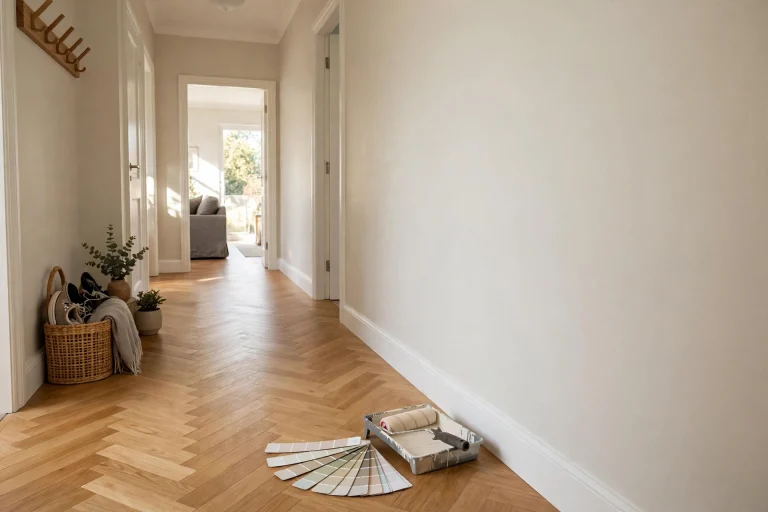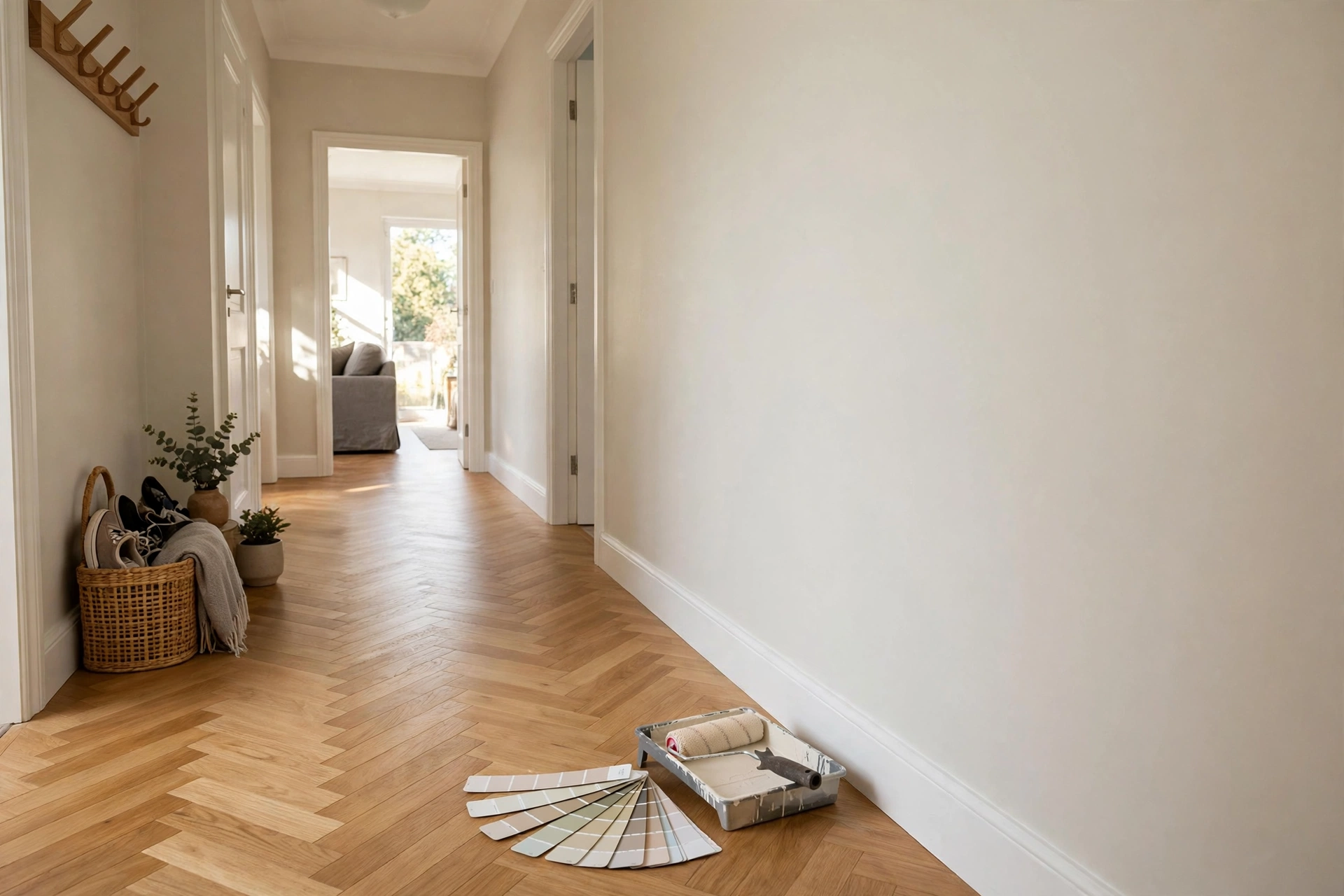
The short answer is satin on the walls and semi-gloss on the trim — and a scuff-resistant paint line if your hallway takes a real beating. That combination gives you walls you can wipe clean again and again without the paint going shiny in patches, and woodwork hard enough to survive bags, shoes, and dogs. Get the finish right and a hallway repaint lasts years instead of months.
Most hallway paint fails for a reason that has nothing to do with the painter. Flat and matte finishes look beautiful in a bedroom, but in a hallway they absorb every scuff, stain, and fingerprint, and scrubbing them only makes a dull patch. The fix is not more coats of the wrong paint — it is a finish built for traffic, chosen zone by zone.
This guide works through the decision in order: why hallways fail, how sheen works, which paint lines are genuinely tougher, how to plan the finish zone by zone, and the prep and touch-up habits that make the result last. No jargon, no brand hype — just the choices that hold up when a hallway gets used hard every day.
Why Hallway Paint Fails Before the Rest of the House
A hallway fails first because the damage is concentrated in narrow bands. Shoulders and bags brush the same stretch of wall at the same height, every single day. Shoes scuff the skirting, hands grab the same part of the handrail, and the wall beside the front door takes a battering from coats, keys, and parcels. No other room in the house gets that kind of repeated contact in such a small area.
Add moisture to the mix and it gets worse. A hallway near an exterior door collects damp from wet coats and muddy shoes, and in many homes it is also the coldest passage in the house, so condensation settles on the walls. Paint that cannot handle washing or damp will show it within a year — scuffs that will not wipe off, stains that sink in, and shiny patches where someone scrubbed too hard.
How Sheen Decides Whether Paint Survives Scuffs
Sheen is simply how much light a dried paint film reflects, and it is the best shorthand for toughness. A flat finish has no sheen and a porous surface that absorbs stains. Eggshell adds a faint glow and a little washability. Satin steps up again with a soft pearl-like sheen that wipes clean readily. Semi-gloss and gloss form the hardest, slickest films, which is why they are the standard for trim — though they show every dent in the plaster underneath.
| Finish | Sheen level | Washability | Best zone |
|---|---|---|---|
| Flat / matte | 0–5% | Poor | Ceilings, quiet rooms |
| Eggshell | 10–25% | Moderate | Bedrooms, light traffic |
| Satin | 25–35% | High | Hallway walls, family rooms |
| Semi-gloss | 35–70% | Very high | Doors, trim, skirting |
| High gloss | 70%+ | Excellent | Handrails, painted floors |
For hallway walls, satin is the practical sweet spot for most homes — tough enough to wash repeatedly, forgiving enough to hide minor wall flaws. If the hallway is near an exterior door and takes real weather, bumping the lower half of the wall up to semi-gloss adds meaningful moisture resistance. The key is choosing the sheen for the zone, not for the whole house: walls, lower walls, doors, and handrails can each carry a different finish and still look coherent if the colour stays consistent.
Scuff-Resistant Paint Lines Worth the Extra Cost
Beyond sheen, the paint formulation itself matters. Standard interior paint uses softer resins; scuff-resistant lines use harder resins that resist shoe marks and bag scrapes while still cleaning with soap and water. They cost more per tin, but in a hallway they pay for themselves by not needing a repaint in two years.
- Benjamin Moore Scuff-X — built for high-traffic walls, very hard-wearing, and a favourite of commercial painters for corridors.
- Sherwin-Williams Scuff Tuff — a scuff-resistant line made for exactly this kind of abuse, with good washability.
- Sherwin-Williams Emerald, satin — premium washable paint with strong stain resistance and excellent burnish resistance.
- Benjamin Moore Aura, satin — excellent colour hold and washability without dulling the film after repeated cleaning.
- Little Greene Intelligent Matt — a washable matt at only 2 percent sheen, rated top class for wet scrub resistance, for homes that want a flat look with real durability.
- Behr Premium Plus, satin — the budget option: low-odour, mildew-resistant, and widely available.
My honest advice: if you have children, dogs, or a narrow hallway, buy the scuff-resistant line. The difference between a standard satin and a Scuff-X wall after a year of daily life is not subtle — one wipes clean, the other has grey arcs at shoulder height that no amount of scrubbing removes. The tin costs more; the repaint costs far more.
One thing to check before you buy: scuff-resistant paints can be thicker and harder to apply than standard paint, so use a good quality roller sleeve and keep a wet edge as you work. If you are hiring a painter, tell them in advance which line you have bought — some painters price differently for the harder-wearing products because they take a little more effort to lay off smoothly. It is still worth it; a paint that is slightly harder to apply but lasts three times as long is the better deal.
How to Test a Paint Before Committing to a Whole Hallway
Never choose a hallway paint from a colour card alone. Buy a small tester pot, paint a patch at least a metre square on the actual hallway wall, and live with it for a few days. Colours change dramatically between the shop and your hallway — the light from the front door, the warm bulbs, and the narrow space all shift how a colour reads. A tester pot costs very little; repainting a whole hallway because the colour looked wrong costs a weekend.
Test the finish as well as the colour. Once the patch is dry, try to scuff it with a bag strap, wipe it with a damp cloth, and press a piece of tape onto it and pull it off. If the paint marks easily, goes shiny where you wiped, or lifts with the tape, it is the wrong paint for a hallway — and you have learned that on a one-metre patch instead of on every wall in the house.
A Zone-by-Zone Finish Plan for One Hallway
The smartest way to paint a hallway is to stop thinking of it as one surface. It is four zones with four different jobs, and each one wants a different finish. Plan it zone by zone and the result lasts longer and looks more considered than a single finish everywhere.
Walls, upper half: satin finish in your chosen colour. Washable, forgiving, and the right look for a passage you live in.
Walls, lower half: satin or semi-gloss, or a washable paint on a dado-height band where bags and shoes hit hardest.
Skirting, doors, and frames: semi-gloss enamel. These are the surfaces that get kicked, grabbed, and knocked — they need the hardest film.
Handrail and newel: semi-gloss or high gloss, for a surface that is touched a hundred times a day and must wipe clean.
Ceiling: flat or matte. It takes no contact, and a flat finish hides imperfections best.
Stairs and treads: a dedicated floor paint or a semi-gloss enamel over a proper primer, never a wall paint.
Keep the colour the same across the zones and the different sheens will read as a deliberate design choice rather than a mistake. The eye notices colour; it barely registers that the skirting is glossier than the wall above it.
Colours That Hide Wear Without Darkening the Passage
Colour is a durability decision in a hallway, even though most people choose it for looks alone. Very pale whites show every scuff as a grey or black mark. Very dark colours show pale chalky scuffs and dust, especially in the raking light from a front door. Mid-tone warm neutrals with a little depth are the most forgiving, because small marks blend into the tone instead of standing out against it.
If you love white, choose a warm white with a little pigment rather than a brilliant white, and accept that you will touch it up more often. A practical compromise many painters use is a slightly deeper colour on the lower half of the wall — a dado-height band in a mid-tone — with a paler colour above. The band hides the scuffs where they happen, and the pale upper wall keeps the passage feeling bright.
One more colour trick worth knowing: a finish with a very slight sheen hides marks better than a dead-flat finish in the same colour, because the light it reflects breaks up the outline of a scuff. That is another reason satin beats flat in a hallway — it is not just tougher, it is visually more forgiving. The same colour in satin will look cleaner for longer than the same colour in flat, with no extra effort from you.
Prep Work That Makes Any Finish Last Twice as Long
The most durable paint in the world will fail on a badly prepared wall, and the cheapest paint will last surprisingly well on a good one. In a hallway, prep means washing the walls to remove years of hand grease and dust, filling every dent and crack, sanding the filler smooth, and priming bare patches. Skip the wash and the new paint peels in sheets within months — hand grease is the enemy of adhesion.
Sand glossy old paint before you paint over it, or the new coat will not grip. Spot-prime filler and bare plaster so the finish does not flash patchy. And give each coat its full drying time: a second coat applied too soon stays soft underneath and scuffs the moment a bag brushes it. Prep is boring, it takes a day, and it is the difference between a hallway that looks good for five years and one that looks tired by Christmas.
Temperature and ventilation matter during prep and painting too. Paint applied in a cold, damp hallway dries slowly and can stay tacky for days, while paint applied in a hot, draughty passage can skin over before it levels, leaving brush marks. Aim for a mild day, open a window for airflow without creating a draught across the wet paint, and keep the heating steady rather than blasting it. The paint tin will tell you the ideal range — follow it, because the chemistry does not care about your schedule.
A Touch-Up Routine That Keeps Hallways Looking Fresh
Even the best hallway paint needs looking after, and a small touch-up routine beats a full repaint every time. Keep a small labelled pot of each hallway paint — wall colour, trim colour, and the exact sheen — stored somewhere cool. When a scuff appears, try a damp cloth with a drop of mild detergent first; most marks on satin and semi-gloss come off that way.
For marks that will not wipe off, touch up with a small brush and feather the edges so the repair blends. Touch up in daylight and let it dry fully before judging the match — wet paint always looks darker. Done this way, a hallway can go years between full repaints, and the only people who notice the touch-ups are the ones who did them.
Keep a note of the exact paint, colour code, and sheen on the back of the stored tin, or taped inside a cupboard door. A year from now you will not remember whether the hallway was satin or eggshell, and guessing wrong means a touch-up that flashes differently in the light. Five seconds with a pen now saves a mismatched patch later.
High-Traffic Paint Finish Questions
What is the best paint finish for hallway walls?
Satin is the best all-round choice for hallway walls: washable, scuff-resistant, and forgiving of minor wall flaws. Eggshell works in a calm hallway without children or pets, and semi-gloss suits the lower half of the wall where bags and shoes hit hardest.
Is satin or semi-gloss better for high-traffic areas?
Satin wins on walls, semi-gloss wins on trim. Satin hides imperfections and cleans well enough for walls; semi-gloss forms a harder film, which is why it belongs on doors, skirting, and handrails that take direct knocks. Use both, zone by zone.
Can I use matte paint in a hallway?
Only a washable matte rated for high traffic, such as a Class 1 scrub-rated matt. Standard flat or matte paint absorbs stains and goes shiny or patchy when scrubbed, so it fails quickly in a hallway. In most homes, satin is the safer choice.
Which paint brands are best for scuff resistance?
Benjamin Moore Scuff-X and Sherwin-Williams Scuff Tuff are made specifically for scuff resistance, while Sherwin-Williams Emerald and Benjamin Moore Aura offer premium washability and stain resistance. For a flat look with real durability, Little Greene Intelligent Matt is rated top class for wet scrub resistance.
How do I clean hallway walls without damaging the paint?
Use a soft cloth or sponge with warm water and a drop of mild detergent, and wipe gently. Avoid abrasive pads and harsh cleaners, which dull the sheen. On satin and semi-gloss finishes, most marks lift this way without any damage to the paint film.
Final Thoughts on Paint That Holds Up in Busy Hallways
A hallway does not need the most expensive paint in the shop — it needs the right finish in the right place. Satin on the walls, semi-gloss on the trim, a scuff-resistant line where the traffic is worst, and a mid-tone colour that forgives a mark or two. Add proper prep and a small pot kept for touch-ups, and the hallway stops being the room you repaint every two years and becomes the one you forget about — which is exactly what a good finish should do.
About the Author